

This question comes up on parenting forums, Reddit threads and pediatric health sites with some regularity—and the answer is more nuanced than a simple yes or no. Most fridge magnets are not chemically toxic. But certain types of magnets, in certain situations, pose a very real physical danger—especially to young children.
Standard decorative fridge magnets are not chemically poisonous. The materials—ferrite, resin, PVC, painted metal—are generally non-toxic in normal handling. The danger is physical, not chemical: small magnets that are swallowed, especially in multiples, can attract through intestinal walls and cause life-threatening internal injuries. According to the U.S. Consumer Product Safety Commission (CPSC), an estimated 2,500 magnet-related ER visits occurred in the US in 2021 alone.
The two parts of this question are worth separating clearly: the chemistry of what fridge magnets are made from, and the actual physical risks they can pose in a household. They're different conversations, and conflating them leads to either unnecessary panic or misplaced reassurance.
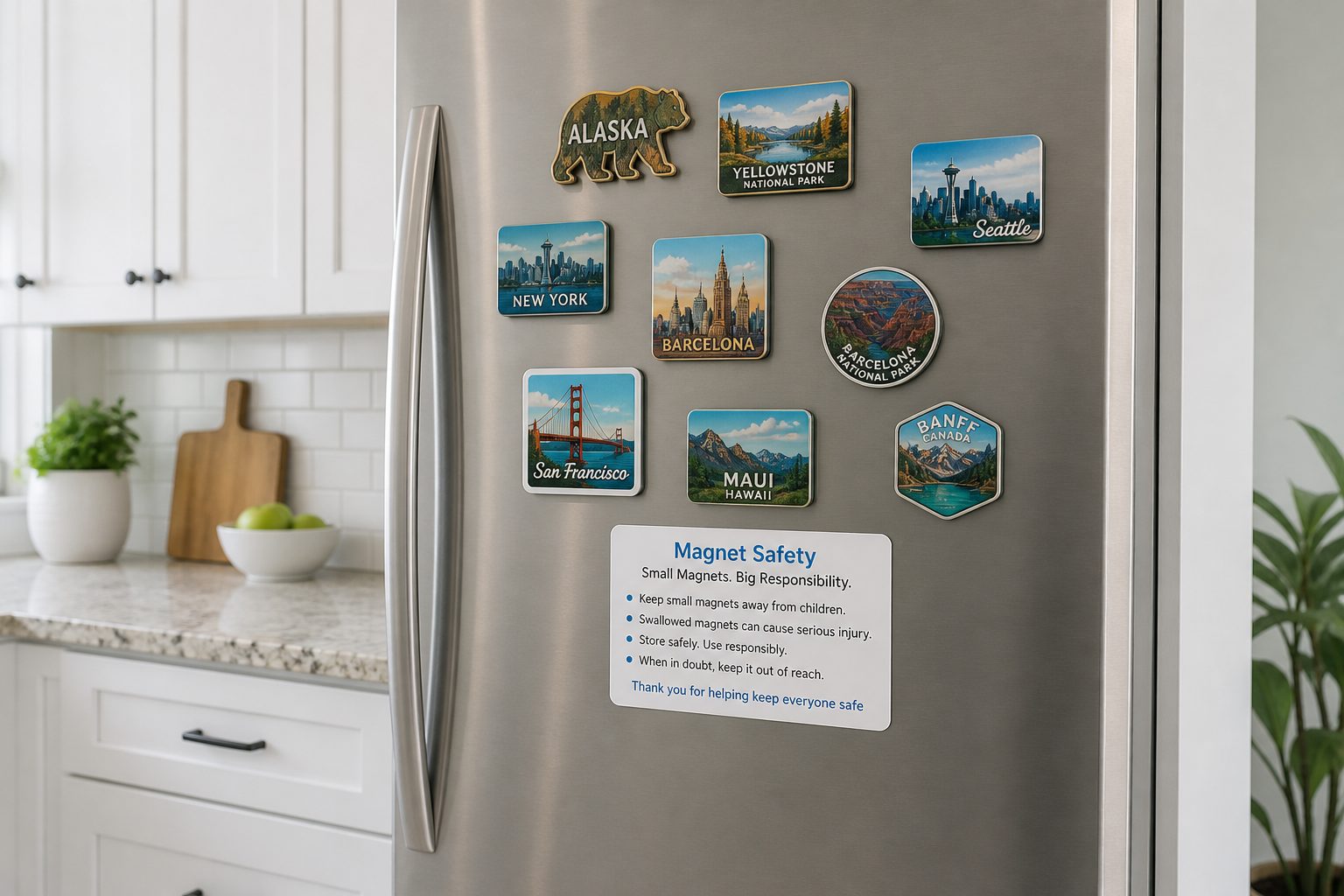
Decorative fridge magnets displayed at adult height on a standard refrigerator. The risk from standard souvenir magnets in normal household use is primarily about placement and access, not chemical toxicity.
What Are Fridge Magnets Made Of?
Most decorative fridge magnets use a small number of well-understood materials. Understanding what's inside answers the toxicity question directly.
| Material | Common use | Toxic if swallowed? |
|---|---|---|
| Ferrite (ceramic magnet) | Magnetic backing layer | Low chemical toxicity; physical hazard if sharp edges |
| Neodymium (rare earth) | High-power toy magnets; not typical souvenir magnets | Low chemical toxicity; extreme physical danger if multiple pieces swallowed |
| Soft PVC | Flexible shaped magnets | Modern PVC without phthalates: low toxicity; older or unregulated PVC may contain plasticizers |
| Polyresin | 3D landmark magnets | Generally non-toxic once cured |
| Metal (zinc alloy, iron) | Die-cast relief magnets | Generally non-toxic; some older products may have lead-based paint |
| Acrylic / epoxy | Flat and dome-finish magnets | Non-toxic when cured |
In normal use—touching, handling, or even accidentally mouthing a standard decorative fridge magnet—the chemical risk is negligible. The materials used by reputable manufacturers are well-established and don't off-gas dangerous compounds in home environments.
The Real Risk: Physical Danger from Swallowing
The conversation changes significantly when we move from chemistry to physics. The specific mechanism of magnet injury is worth understanding because it's not intuitive.
If a child swallows two or more magnets at different times, they can attract to each other through the walls of the intestine or bowel. This creates pinch points that cut off blood supply, perforate tissue and cause infections or necrosis requiring emergency surgery. The injury isn't from the magnet material itself—it's from the magnetic force acting across soft tissue.
⚠ According to a 2025 study published in BMJ Injury Prevention, magnet ingestion cases among US children rose sharply even after stricter CPSC regulations took effect in 2014. The CPSC estimated approximately 2,500 magnet ingestion ER visits in the United States in 2021. In the UK, around 300 children were admitted to A&E in a single year after swallowing magnets, with one in ten requiring life-saving operations.
Are standard fridge magnets as dangerous as toy magnet sets?
Not quite—but the distinction requires care. The magnets most frequently involved in serious injuries are high-powered neodymium magnet sets—the small shiny ball magnets sold as desk toys. These are significantly stronger than the ferrite magnets in most decorative fridge magnets.
However, any small magnet, regardless of strength, poses a choking risk to children under three. And any magnet small enough to be swallowed can cause the dangerous attraction-through-tissue scenario if multiples are involved. Most standard destination fridge magnets—5–8 cm across—are not realistic swallowing hazards for older children. Smaller novelty formats warrant more care.

Factory quality control includes checking for sharp edges, loose components and coating integrity—all factors that affect both safety and retail durability.
Regulatory Standards That Apply
Regulators have taken the magnet hazard seriously, though the rules primarily target toys and high-powered magnet sets rather than standard decorative magnets.
- United States: The CPSC's final rule on magnet safety standards (2022) restricts the flux index of consumer magnets. Standard ferrite fridge magnets typically fall well below the restricted threshold. ASTM F963 governs magnets in children's toys.
- European Union: EN 71-1 (toys) and the General Product Safety Directive apply to magnets marketed or likely to be used by children.
- UK: Post-Brexit, the UK retained equivalent standards; the Office for Product Safety and Standards (OPSS) monitors compliance.
Lead Paint: A Historical Issue, Mostly Resolved
One toxicity concern that surfaces for older or cheaply produced magnets is lead-based paint. In the early 2000s, several product recalls involved Chinese-manufactured toys and gifts with lead paint exceeding safe limits.
Since 2008, CPSC regulations have imposed strict limits on lead content in surface coatings for children's products (90 ppm in paint). Most reputable souvenir manufacturers now use lead-free paints as standard. If you're sourcing magnets for a school, museum or gift shop that serves families, confirming lead-free certification is a reasonable quality check to include in your supplier brief.
Safe magnet use: a practical checklist
- Keep small magnets (under 3 cm) out of reach of children under 14, not just under 3
- If a child swallows a magnet, seek emergency medical attention immediately—do not wait for symptoms
- Check fridge magnets regularly for cracks or broken pieces
- For families with young children, prefer larger one-piece magnets over sets or small novelty designs
- When buying for gift shops, request lead-free and phthalate-free certification from your supplier
- Products for children should carry CE (EU), UKCA (UK) or equivalent certification
What If Someone Has Swallowed a Magnet?
If you believe a child has swallowed a magnet—even one magnet—contact emergency services or a poison control centre immediately. Do not wait for symptoms.
- US Poison Control: 1-800-222-1222 (24 hours)
- UK NHS: Call 111 or go to A&E
- EU: Contact your national poison information centre (listed at EAPCCT.org)
A single swallowed magnet may pass safely. The risk multiplies sharply if more than one magnet is involved, or if the child also has metallic objects in their digestive tract. Imaging is typically needed to confirm the situation.
For Retailers: What to Know Before You Stock
If you're a gift shop, museum store or tourism retailer buying fridge magnets to sell, the safety question has a practical commercial dimension. When sourcing from a manufacturer, ask specifically about lead-free and phthalate-free certification for PVC products, compliance with ASTM F963 (US) or EN 71 (EU) if the product could be handled by children, and whether test reports are available from an accredited third-party lab.
At jaxmory, all custom fridge magnets for export markets are produced with lead-free coatings and PVC that meets standard phthalate restrictions. If your buyer market requires specific certification documentation, include that requirement in your initial product brief so it can be factored into material decisions from the start.
This article is for general informational purposes and does not constitute medical or legal advice. If you believe a child has swallowed a magnet, contact emergency services immediately.
FOUNDER PERSPECTIVE
Build souvenirs people choose to keep.
Hi, I am Bora, founder of jaxmory. I started this company to help destination retailers turn a place, collection or brand story into products that feel specific, useful and ready for the shelf.
When you share a range idea, I look at the memory behind it first, then the product format, material and commercial path. That keeps the conversation grounded in what visitors will understand and what buyers can confidently reorder.

DIRECT ENQUIRY